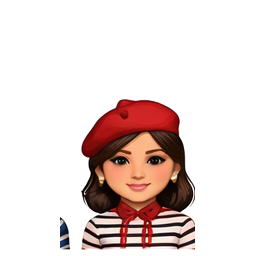
Our university offers a documentary environment oriented toward exploratory navigation. The few mechanisms described below determine the behavior of the home page; they are transparent by construction, so that each action remains predictable and reversible.
1. Characters displayed at the bottom of the screen
- Clicking on the teacher opens a selection window offering a gallery of illustrations. The chosen option replaces the teacher’s image and persists in the browser’s local storage: the retained visual identity is restored on later visits, as long as the site data is not erased.
- Clicking on the student opens an independent thumbnail from a complementary module. The thumbnail can be moved by drag and drop and closed without affecting the rest of the page.
These choices have no effect on the documentary selection: they are purely cosmetic and local. No data is transmitted to the server when the selection is made.
2. Ethical rules for spontaneous suggestions
The blackboard proposes, each time the home page loads, three subjects randomly selected from the listed content. This draw is subject to a filter defined in our ethical policy.
Three important consequences follow from this:
- The filter applies only to unsolicited suggestions.
- The filter is deliberately conservative.
- The filter is based on a principle of hospitality: we avoid showcasing, to a visitor about whom we know nothing, subjects likely to offend the majority sensitivities associated with the interface language they have chosen. Language is used here as an imperfect proxy for the probable cultural context; it is neither an assigned identity nor a rigorous presumption.
- All content remains accessible through explicit search and through navigation in the faculty tree. This is not a documentary censorship policy, but an adjustment of the showcase.
- When in doubt, a subject is kept out of the showcase rather than proposed. This choice recognizes that it is less harmful not to suggest a legitimate subject than to impose it on a reader for whom that subject carries a particular weight.
- Some exclusions reflect local legal constraints (laws on blasphemy, on the denial of historical crimes, on lèse-majesté, etc.) rather than homogeneous popular sensitivities. The two registers are not equivalent; exclusion does not mean approval of the underlying norm. It only aims not to expose a visitor to a risk they did not choose to take.
The list of sensitive keywords is available here. It is iterative and intended to be corrected; documented feedback is welcome.
Two more discreet editorial axes coexist with this language filter: a pedagogical priority which slightly emphasizes certain subjects in the random draw, and a content warning which places a small amber dot on subject cards documenting harmful practices. Neither one filters access; both are detailed in the ethical policy.
3. Search and random selection of themes
Two distinct mechanisms coexist to access the content:
- Explicit search is accessible from a text field with live suggestions, selection from frequent searches, and navigation by sections. It queries a prebuilt index and is not subject to any ethical filter: the user who formulates a query is presumed to know what they are looking for.
- The themes highlighted are the result of a random draw among the content listed in our internal mapping.
Each reload of the page therefore changes the selection. The proposals are not a ranking, nor an editorial promotion: they are an invitation to discovery, deliberately neutral regarding the hierarchy of content.
Consultation statistics, if they exist, are not used to weight this draw. The criterion is strictly the ethical eligibility of the subject for the visitor’s active language.
4. Access to the university and paid options
Entry to the university is free. Viewing the sheets, browsing the sections, searching and using the blackboard require no account, no payment and no registration.
Some particular sections or features do however require being logged in and provided with a badge associated with your profile. The badge certifies that the user meets a specific condition — age, institutional affiliation, verified skill — required to open access to sensitive documents or advanced tools.
Finally, some options must be gap swaps, Gapit’s internal currency. The price of each option, its duration and its billing method are described in a open catalog.
Transparency and evolvability
All the rules described here are implemented in readable source files. Revising them is an ordinary maintenance action, not an exceptional intervention. Reports of errors, omissions or bias are handled in the same way as reports of technical bugs.